Choosing the right entrance exam is an important step for students planning to study in Italy. For many years, students prepared for different English TOLC exams like TOLC-I, TOLC-E, and TOLC-F. Each test had its own pattern and rules, which often created confusion among international applicants.
To solve this problem and make the process clearer, CISIA introduced a new unified exam called CEnT-S. This guide explains the complete registration process, structure, macro-periods, and mistakes to avoid.
Quick registration takeaways
- 01
CEnT-S replaces the older English TOLC-I, TOLC-E, and TOLC-F routes for many science-based programmes.
- 02
You can usually choose between @UNI test centres and @HOME remote testing, depending on university rules.
- 03
International students should avoid late macro-periods when visa and pre-enrollment timelines are tight.
01 — ContextWhat Was Before CEnT-S?
Earlier, CISIA used different English TOLC tests for different fields:
- TOLC-I English for Engineering and Computer Science
- TOLC-E English for Economics and Business
- TOLC-F for Pharmacy and Biology-related programmes
Each test had different sections, timings, and styles. Students often had difficulty understanding which exam was right for their chosen degree.
Old English TOLC routes vs CEnT-S
| Route | Typical use | Student experience |
|---|
| TOLC-I English | Engineering and Computer Science | Separate structure and preparation path |
| TOLC-E English | Economics and Business | Different subject mix from science tracks |
| TOLC-F | Pharmacy and Biology-related programmes | Course-specific preparation confusion |
| CEnT-S | Science, engineering, economics and related English-taught degrees | One clearer exam structure for multiple programmes |
What Is the CEnT-S Exam and Why Was It Introduced?
To remove this confusion, CISIA created a single standardised test for multiple scientific and technical programmes. CEnT-S replaces the earlier English versions of TOLC-I, TOLC-E, and TOLC-F for science-based degree courses.
The main goals were:
- one unified exam
- same structure for everyone
- easier exam booking
- better clarity for international students
CEnT-S stands for CISIA English Test - Sciences. It is required for admission to many English-taught bachelor's programmes in Italy, such as Engineering, Computer Science, Economics, Business, Biology, and Pharmacy-related courses.
You can take the exam in two modes:
- @UNI at a university test centre
- @HOME online remotely with monitoring
The exam is managed through CISIA's official platform.
03 — TimelineWhy Early CEnT-S Attempts Matter
It is important to take the CEnT-S exam in the first or second macro-period to avoid missing university admission deadlines. These early periods allow enough time for pre-enrollment, merit evaluation, and visa procedures, especially for international students.
Because of this, students must prepare with the right resources, without confusion or outdated study materials. Many students still use old TOLC books, which no longer match the new structure.
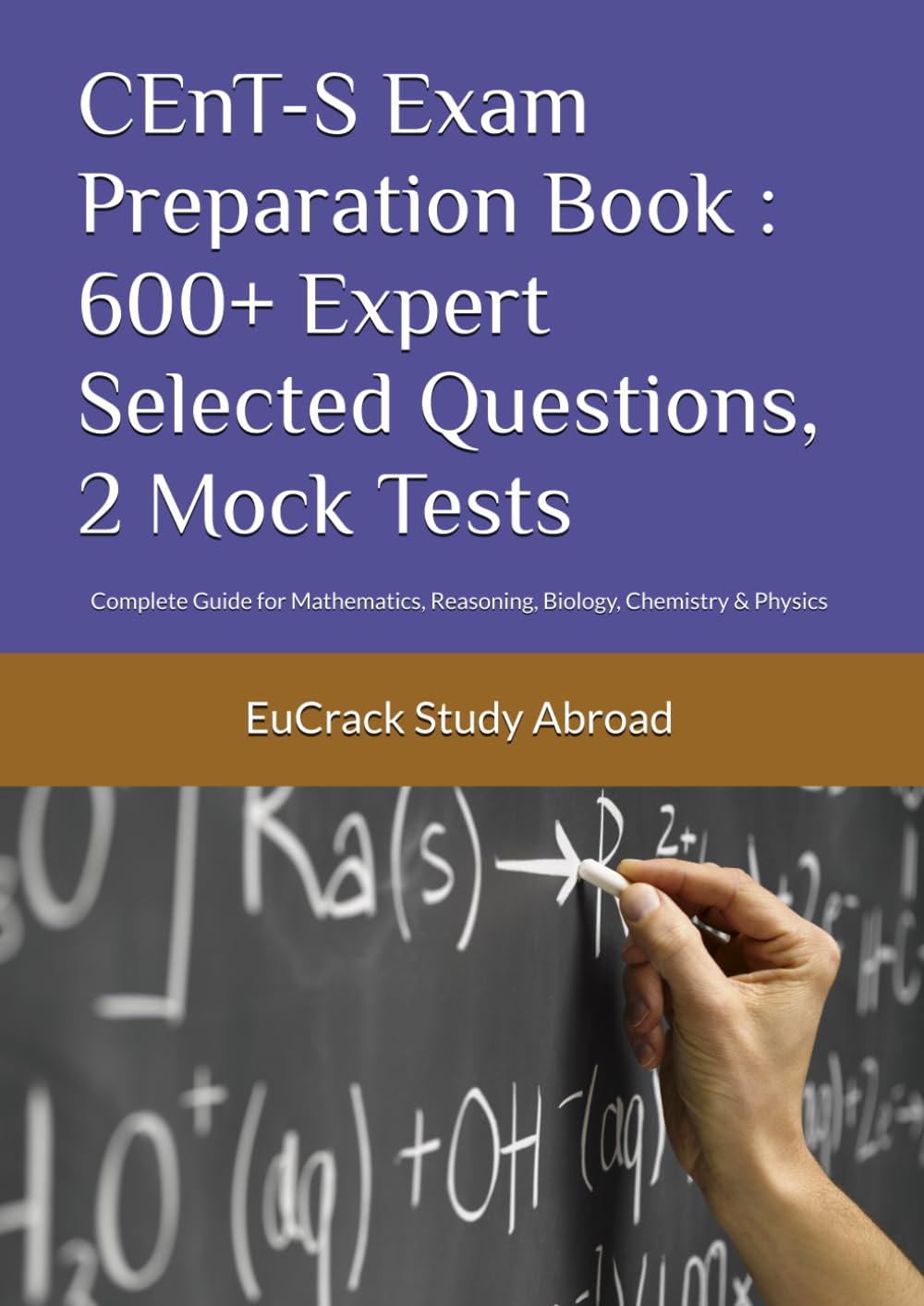
At EuCrack, we created the CEnT-S 2025 Preparation Book, developed with Italian institutes, university professors, and CEnT-S exam experts.
04 — ProcessHow to Register for the CEnT-S Exam
CEnT-S registration process
- Create your CISIA Student Area account
Visit the official CISIA website and create your Student Area account.
Open CISIA - Check available test dates
Inside your Student Area, review available dates and read the official CEnT-S structure page.
Check structure - Choose exam mode
Select either @UNI or @HOME, depending on what your target university accepts.
- Book your CEnT-S slot
Use the official booking page and confirm the selected test window.
Booking page - Pay the exam fee
The CEnT-S exam fee is EUR 55 as per the official CISIA fee.
- Prepare for exam day
Keep your booking receipt, valid ID, stable internet for @HOME, webcam, and a quiet room ready.
05 — StructureCEnT-S Exam Structure
The CEnT-S exam includes 55 questions across five timed sections. The full test lasts 110 minutes.
| Subject / Section | No. of Questions | Time |
|---|
| Mathematics | 15 | 30 minutes |
| Reasoning on Texts and Data | 15 | 30 minutes |
| Biology | 10 | 20 minutes |
| Chemistry | 10 | 20 minutes |
| Physics | 5 | 10 minutes |
| Total | 55 | 110 minutes |
Marking Scheme and Normalisation
- +1 for a correct answer
- 0 for no answer
- -0.25 for a wrong answer
The final official score is released after the macro-period ends following CISIA's normalisation process.
07 — TimelineMacro-Periods
CEnT-S is offered four times a year. For international non-EU students, the first or second macro-period is strongly recommended.
CEnT-S macro-period planning
- Period 01
November to January
Best early window for students who want more time for applications and visa steps.
- Period 02
February to March
Strong backup window for international applicants who missed Period 01.
- Period 03
April to June
Useful for some programmes, but can be late for many non-EU timelines.
- Period 04
September to October
Usually better for later admission rounds or future planning, not urgent visa cases.
08 — AvoidCommon Mistakes Students Should Avoid
Many students face issues because they are not aware of common mistakes. One major mistake is booking the exam too late in a macro-period, which often results in missing university deadlines.
Another frequent issue is choosing the wrong mode without checking what the chosen university accepts. Students taking the @HOME test sometimes forget to test their internet connection, webcam, and environment.
Some students also follow old TOLC materials that are no longer useful for the CEnT-S format. Another misunderstanding is assuming that the raw score shown after the test is the final score, while the official score is visible only after normalisation.
CEnT-S registration FAQs
Can I still use old TOLC books for CEnT-S?+
Old books can help with basic concepts, but they do not fully match the new CEnT-S structure and timing.
Is @HOME easier than @UNI?+
Not exactly. @HOME can be convenient, but it requires strict technical setup, a quiet room, and stable monitoring conditions.
Should non-EU students wait for later macro-periods?+
Usually no. Earlier attempts give more time for pre-enrollment, university evaluation, and visa processing.
Is the raw score my final official score?+
No. The official score is released after normalisation at the end of the macro-period.
Final Thoughts
The CEnT-S exam is now the main entrance test for English-taught science and engineering degrees in Italy. By understanding the registration process, exam structure, macro-periods, and common mistakes, you can complete your application smoothly.
Recommended Resource
EuCrack Study MaterialCEnT-S Exam Preparation Book
If you want structured practice instead of random PDFs, this book gives you 600+ expert-selected questions, 2 full mock tests, and explanations across Mathematics, Reasoning, Biology, Chemistry, and Physics.
600+Questions
2Mock Tests
5Sections